 PawnEasy Pro
The short version
- Gold loan software is four things joined together: a rate board, a valuation, an interest engine and a custody record.
- The valuation is arithmetic anyone can do. The value is in doing it the same way every time, and being able to show the customer how.
- The part that separates usable software from a spreadsheet is what happens when you change an interest scheme after loans are already running on it.
What the term actually covers
"Gold loan software" gets used for everything from a billing app with a gold field bolted on to a core banking system. For a pawn shop or a small gold finance business it means something fairly specific: a system that can take a piece of jewellery across the counter, turn it into a defensible loan amount, and then keep track of the money and the metal separately until the customer comes back.
Those are two different jobs and most of the trouble people have with software comes from products that only do one of them well.
The four parts
1. The rate board
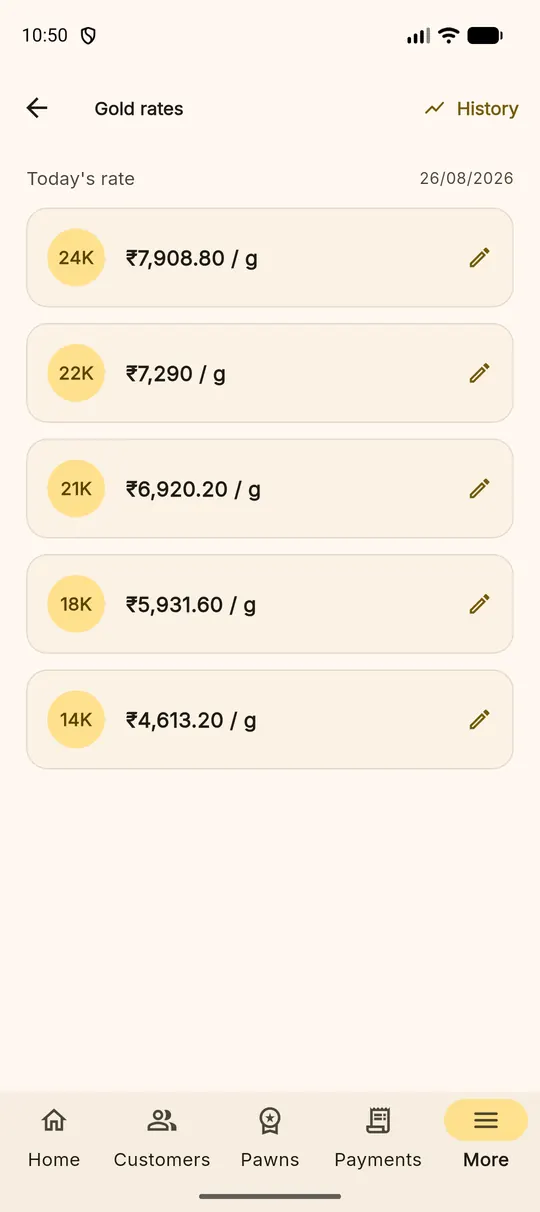
Gold moves daily, so the first thing any gold loan software needs is a rate you set each morning, per karat. Per karat matters: a 22k rate should be the price of a gram of 22k, not the fine-gold price that something else will scale down later. Systems that scale twice quietly under-lend, and nobody notices for months.
The second thing that matters is that old rates are kept rather than overwritten. A loan written in March has to be explainable by March's rate, not by today's.
2. The valuation
The arithmetic is not complicated:
- gross weight − stones and wastage = net weight
- net weight × the karat rate = gold value
- gold value × your loan-to-value percentage = the maximum loan
Anyone can do that on a calculator. What software adds is that it is done the same way by every member of staff, on every pledge, and that all four numbers stay on the screen while the customer is standing there. A valuation you can show is a valuation you can defend; a number that appears out of a clerk's head is an argument waiting to happen.
3. The interest engine
This is where most products are decided. Interest on a gold loan is not one formula — it is monthly or daily or flat, it may have a grace period, it may have a penalty rate after a certain point, and different products in the same shop may work differently.
The question to ask any vendor is this: if I change a scheme next year, what happens to the loans already written on it? If the answer is that they recalculate, the software is not trustworthy — a customer's dues would change because of an administrative edit they never agreed to. The right answer is that each loan keeps its own copy of the terms it was written under, and a scheme change only affects loans written afterwards.
4. The custody record
The money side and the metal side are separate problems. A loan is a balance; an article is a physical object in a locker that somebody will eventually ask for by name. Gold loan software that only tracks the loan leaves you searching the safe.
What you want is a record per article — description, weight, purity, a code — and a movement history that is appended rather than edited. When a piece is disputed a year later, an append-only trail answers the question. An editable one does not.
What it does not do
It does not price your gold for you: the rate board is yours to set, because your buying rate is a commercial decision, not a market lookup. It is not accounting software, and it should not pretend to be — what it owes your accountant is a clean export. And it will not make an overdue customer pay; it will only tell you which ones to call, a week before rather than a month after.
Choosing one
Three questions get you most of the way:
- Can I write one real pledge, end to end, in the trial — and does the interest it produces match what my book says?
- What happens to existing loans when I edit a scheme?
- Can I get my data out, in a format I can read, without asking anyone?
If you want to see how one system answers those, our gold loan software page walks through the rate board, the valuation and the interest in order, and the interest calculation post works through the arithmetic with a real example.