 PawnEasy Pro
The short version
- Interest stops being reproducible once rates, tenures, renewals and part payments multiply.
- Retrieval becomes the bottleneck: a customer at the counter, five thousand live pledges, one chain.
- Due dates live in somebody's head, and collections depend on whether that person came in today.
None of this is an argument that paper is unprofessional. A well-kept register run by someone who has done it for thirty years is a genuinely good system. The argument is narrower: paper does not scale, and it cannot be in two places at once.
Problem 1 · Interest that cannot be reproduced
At twenty live loans on one scheme, mental arithmetic is fine. The trouble starts when the shop is running several rates, several tenures, renewals, part payments, overdue penalties and a couple of customer categories at the same time.
Now two clerks compute the same closing figure differently, and both are defensible. The customer notices. Worse, nobody can reconstruct in March what was charged in November.
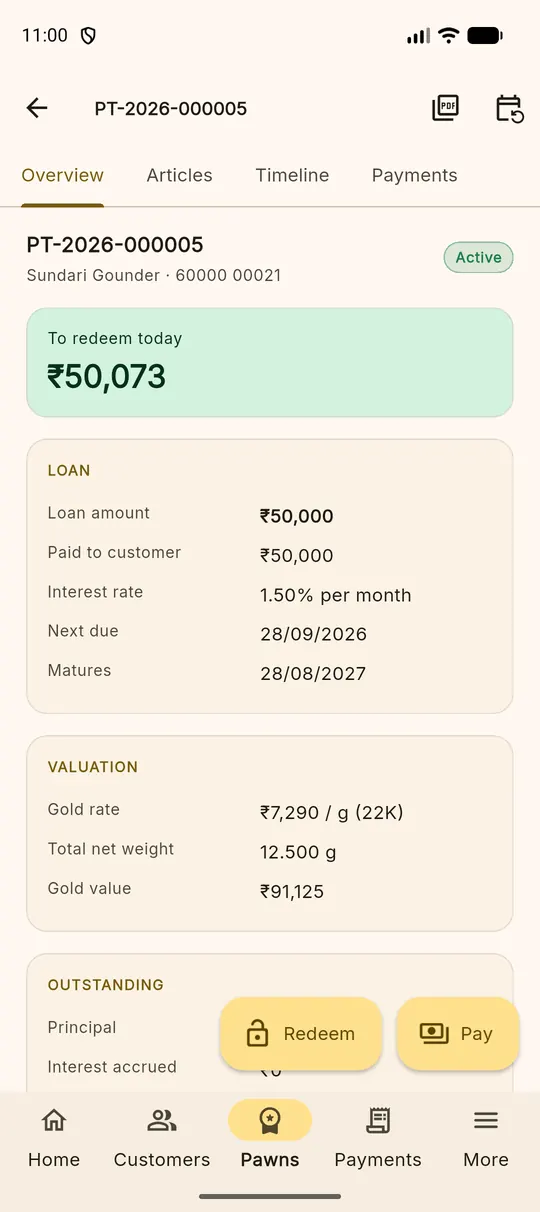
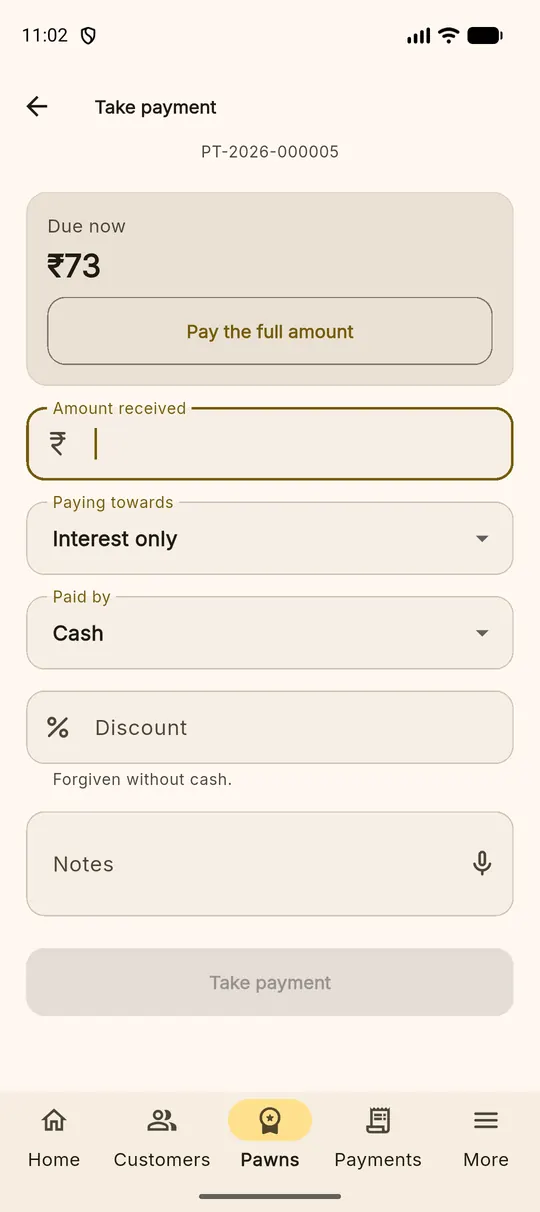
Software fixes this by making the calculation a property of the loan rather than of whoever is standing at the counter. In PawnEasy Pro, each pledge takes a frozen copy of the scheme it was written on — rate, method, tenure, grace period, penalty, rounding. Change your rates next week and not one existing loan moves by a rupee.
Problem 2 · Finding the article
Picture five thousand live pledges. A customer arrives and says: I pledged this chain about six months ago. They do not have the ticket. They may not remember the month.
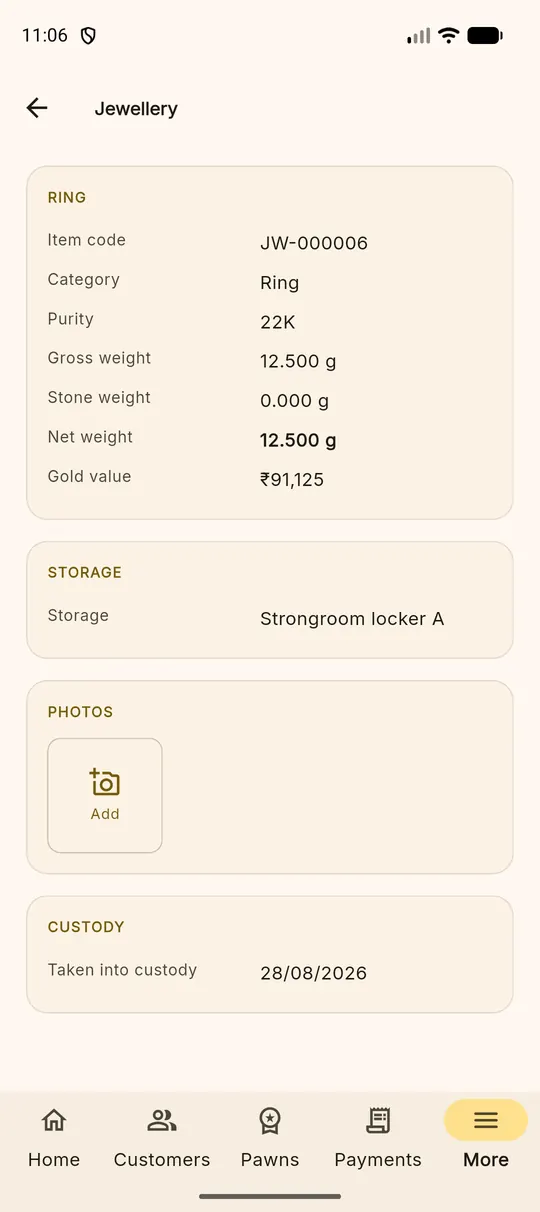
To serve them, the counter needs the customer record, the pledge number, the loan amount, the article description and weight, the interest position, the due date and — the part that actually takes the time — the storage location.
On paper that is a search through a register and then a search through the strongroom. In a digital system it is one query: type a name or a mobile number, open the loan, read the locker off the article.
This is also the difference between a shop that can hire and one that cannot. Retrieval knowledge held in one person's memory is a hiring ceiling and a holiday problem. Retrieval knowledge in a system is training that takes an afternoon.
Problem 3 · Due-date management
Pawn businesses run on dates: interest due, maturity, renewal windows, the point at which an unredeemed article enters the prescribed procedure. Miss them quietly and the loss is invisible for months — a book that looks healthy while collections drift.
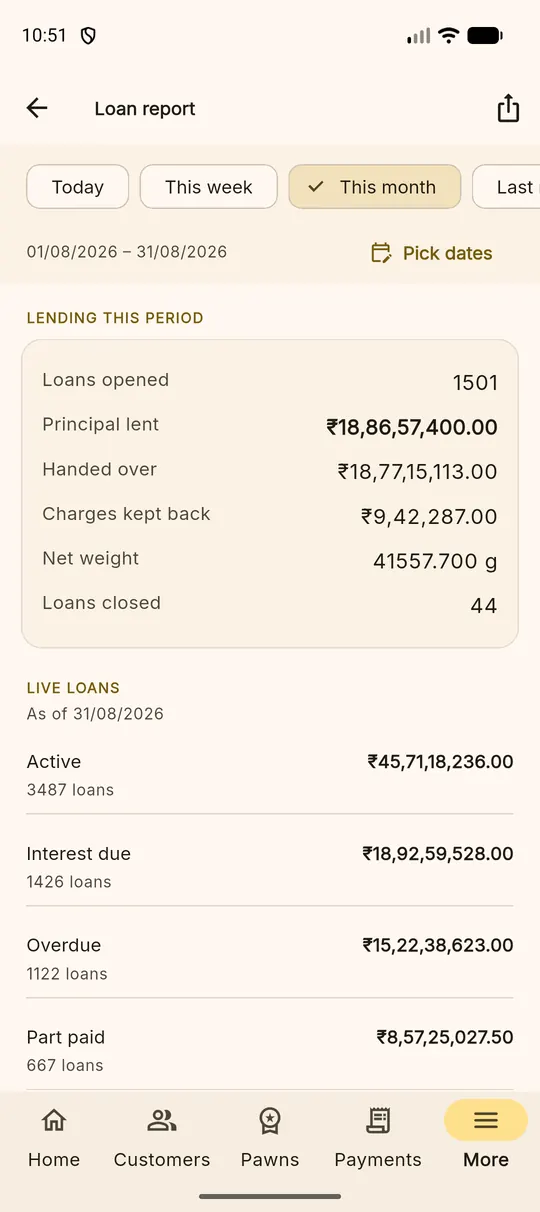
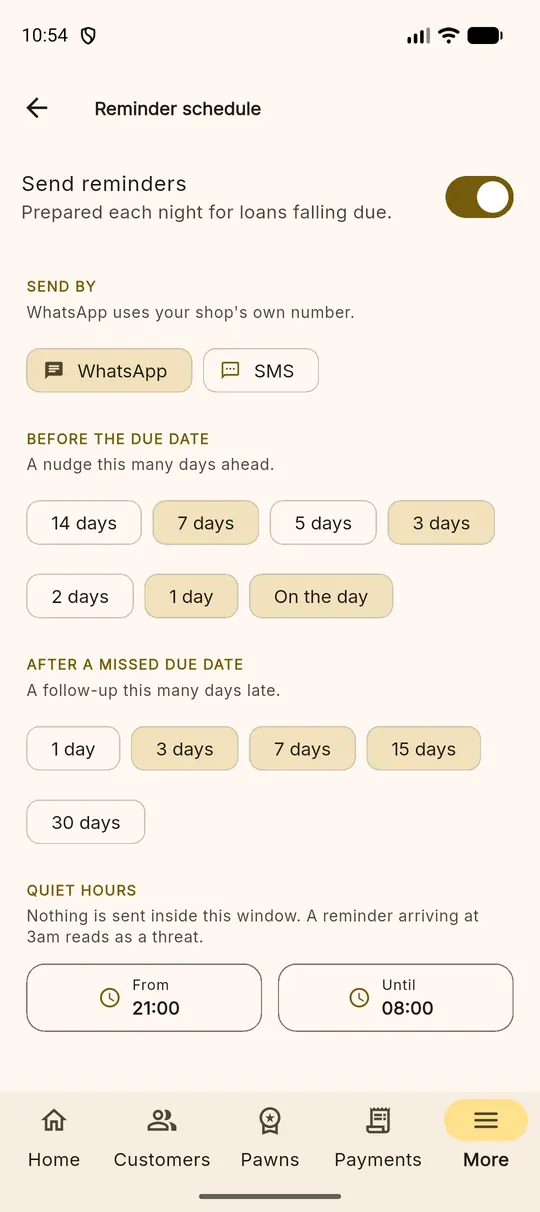
What a shop needs is not one more list but the same list, sorted differently, on demand: due this week, overdue, matured, closed. That is what the loan book report is, and it is why reminders are worth automating: interest due soon, due today, overdue, sent from your own WhatsApp number, in wording you wrote.
What a digital pledge record actually contains
The single most useful artefact software produces is not a report. It is the pledge record itself — the thing a handwritten line in a register is a lossy summary of:
| Field | Example |
|---|---|
| Pledge number | PT-2026-000184 |
| Customer | Name, mobile, address, ID on file |
| Article | Gold chain, 22K, with photographs |
| Gross weight | 24.800 g |
| Net weight | 22.100 g after stones and wastage |
| Valuation | Rate per gram on the day, gold value, maximum loan |
| Loan | Amount, fees, cash actually paid out, payout method |
| Terms | Interest rate and method, frozen at creation |
| Dates | Pledged, next due, matures |
| Storage | Strongroom locker A, or the bank, or a named custodian |
Everything else — receipts, reminders, reports, the daybook — is that record read a different way.
And the customer file behind it
A customer should be entered once and reused for every pledge they ever bring: contact details, address, ID and photographs, previous pledges, live loans, outstanding interest, payment and redemption history — searchable by name, mobile, pledge number or article. See Customers and KYC for how identity numbers are encrypted and shown back only as their last four digits.
On the counter and at the desk
One practical note, because it decides whether any of this gets used: the clerk needs it on a phone at the counter, and the owner needs it in a browser at the desk. PawnEasy Pro is both — an Android app and a web portal on the same books, so a loan written on a handset is on the office PC immediately.