 PawnEasy Pro
The short version
- Three common methods — monthly, daily and flat — give genuinely different answers on the same loan.
- A part payment is normally allocated to interest first, then principal. Which order you use changes what the customer owes next month.
- The rule that matters most is not a formula: it is that a loan must keep the terms it was written under, whatever you change later.
Why this is worth writing down
Almost every disagreement at a pawn counter is about interest. Not fraud — arithmetic. The customer counted months one way, the shop counted them another, and the register does not show the working. Software only helps if it applies one rule consistently and can show what it did.
The three methods
Monthly
Interest accrues per month at a rate per hundred rupees or as a percentage. The detail that varies between shops is what happens to part-months: some charge a full month the day it begins, some pro-rate. Both are defensible; what is not defensible is doing it one way in January and the other way in June.
Daily
Interest accrues per day, which is the fairest method for short pledges and the one customers understand best when they redeem after eleven days. It requires the system to know the exact date the loan started and to count from it — which sounds obvious, and is exactly the thing a paper register gets wrong when the page is written up later.
Flat
A fixed charge for a fixed term regardless of when the customer comes back. Simple to explain, and predictable for the shop, but it means an early redemption pays the same as a late one.
A worked example
Take a loan of ₹50,000 at 2% a month, redeemed after 3 months and 12 days.
- Monthly, full month on entry: 4 months × ₹1,000 = ₹4,000
- Monthly, pro-rated: 3 months × ₹1,000, plus 12/30 of ₹1,000 = ₹3,400
- Daily, at the equivalent daily rate: 102 days × ₹32.88 ≈ ₹3,354
Same loan, same rate, same customer — a spread of ₹646. None of the three is wrong. What would be wrong is not knowing which one your shop uses, or using different ones on different loans because two people worked out the figures.
Grace periods and penalty rates
Most schemes allow a few days after the due date before a penalty rate applies. Two things go wrong here in practice. The first is that the grace period is remembered rather than recorded, so it stretches for favoured customers. The second is that the penalty rate gets applied to the whole loan from the start rather than to the overdue period — which is a much larger number, and the one that produces an argument.
How a part payment should be allocated
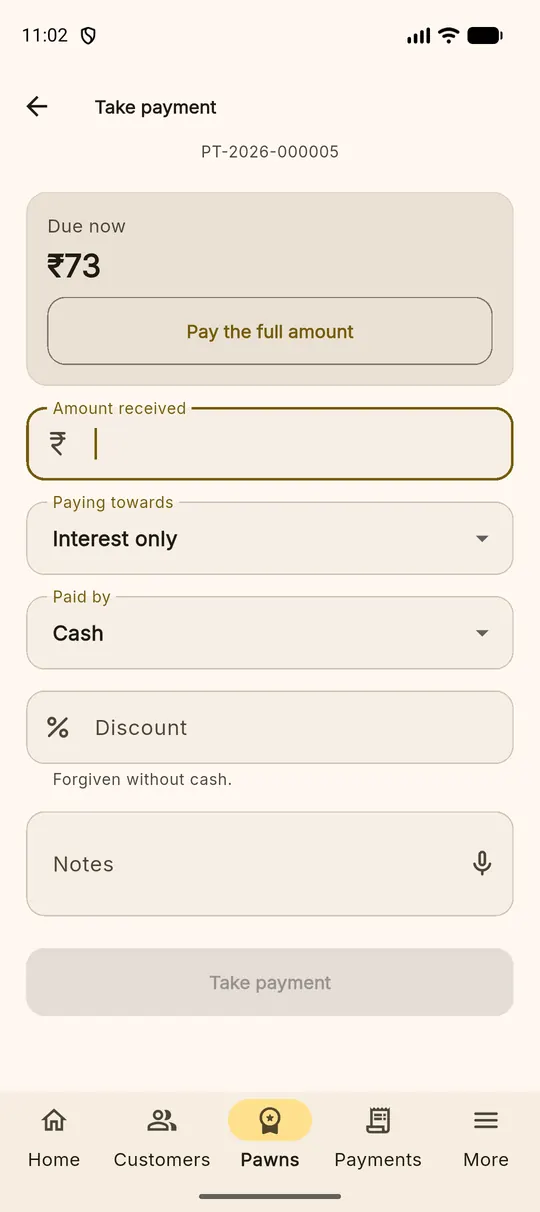
The normal convention is interest first, then principal. If a customer owes ₹1,600 of accrued interest on a ₹50,000 principal and pays ₹5,000, the balance becomes ₹46,600 with interest cleared to date. Allocating principal first instead would leave interest accruing on an amount that has already been partly repaid, and the customer's total cost would quietly rise.
The rule that matters more than the formula
Interest schemes change. Competition moves, the cost of funds moves, and a shop that has been lending at 2% starts lending at 1.75%. The question is what that does to the four hundred loans already running.
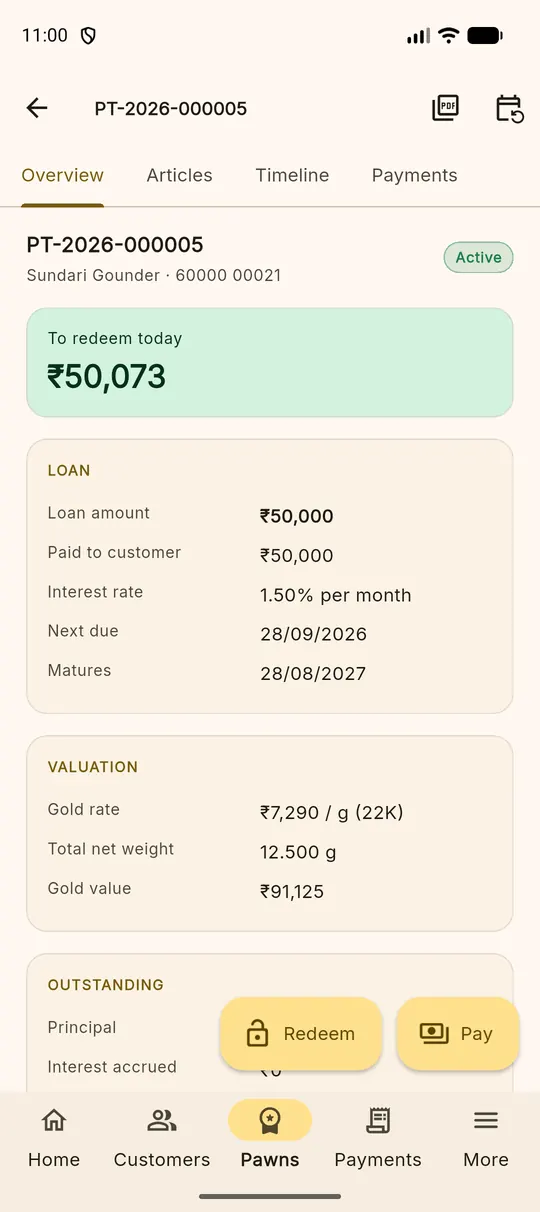
The answer has to be: nothing. A loan should carry a frozen copy of the terms it was written under — the method, the rate, the grace period, the penalty — so it goes on being calculated the way it was agreed. Software that recalculates old loans against a new scheme is not saving you work; it is changing what customers owe, retroactively, without telling them.
What to check in any system
- Write one loan you already know the answer to, and see whether the software agrees with your book.
- Take a part payment on it and check the allocation.
- Change the scheme, then reopen that loan. If the figure moved, stop there.
How PawnEasy Pro handles all three is described on the gold loan software page, and the payments guide shows the screens.