 PawnEasy Pro
The short version
- Pawn broker software is pawn shop software plus the things a licensed business needs: KYC it can hold safely, evidence of custody, and a record of who did what.
- The obligations are the same whether you have one counter or six. The software should not make you pay for six to get them.
- An audit trail is only worth having if it cannot be edited.
Where broker software differs from shop software
A pawn shop needs to write pledges, take payments and find a chain. A pawn broker needs all of that, and then needs to be able to answer questions from outside the shop — from a customer disputing a redemption, from a partner asking what the book is worth, from anyone with a legitimate interest in how a pledged article was handled.
That difference shows up in three places.
1. KYC you can hold without carrying the risk
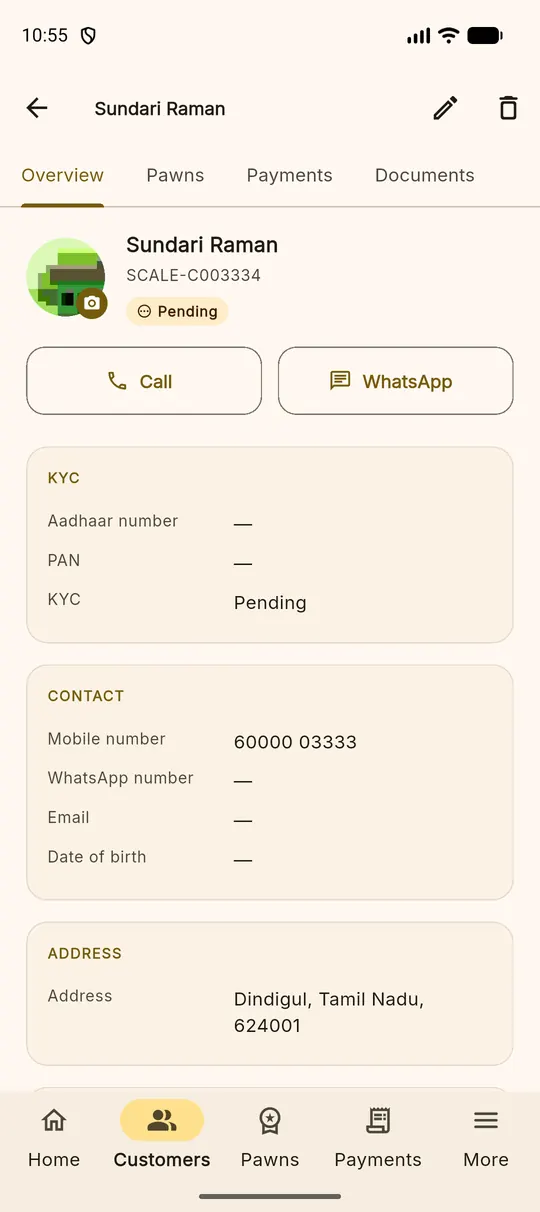
Brokers are expected to identify their customers. That means holding identity numbers, and holding identity numbers is a liability as much as a requirement — the shop that keeps photocopies of Aadhaar cards in a drawer has taken on a risk it gets nothing for.
What good software does is store the number encrypted, then never show it in full again — not on screen, not in an export, not through an API. Staff who need to check a customer against the document in their hand see the last four digits, which is enough for that job and useless to anybody else.
2. Custody you can prove
The single most valuable record a broker keeps is not the loan — it is the history of the article. Where it went when it arrived, which locker it sat in, who moved it, and when it left.
The important property is that this history is append-only. Nothing changes location or status without a movement being written, and movements are never edited or deleted. A trail that can be corrected after the fact proves nothing, because anybody looking at it knows it could have been corrected. One that can only be added to is evidence.
The same logic applies to money. A payment taken by mistake should be reversed with a reason, leaving both entries in the day book, rather than deleted so the day balances. A book that always balances because mistakes disappear is not a book anybody should trust.
3. Who did what
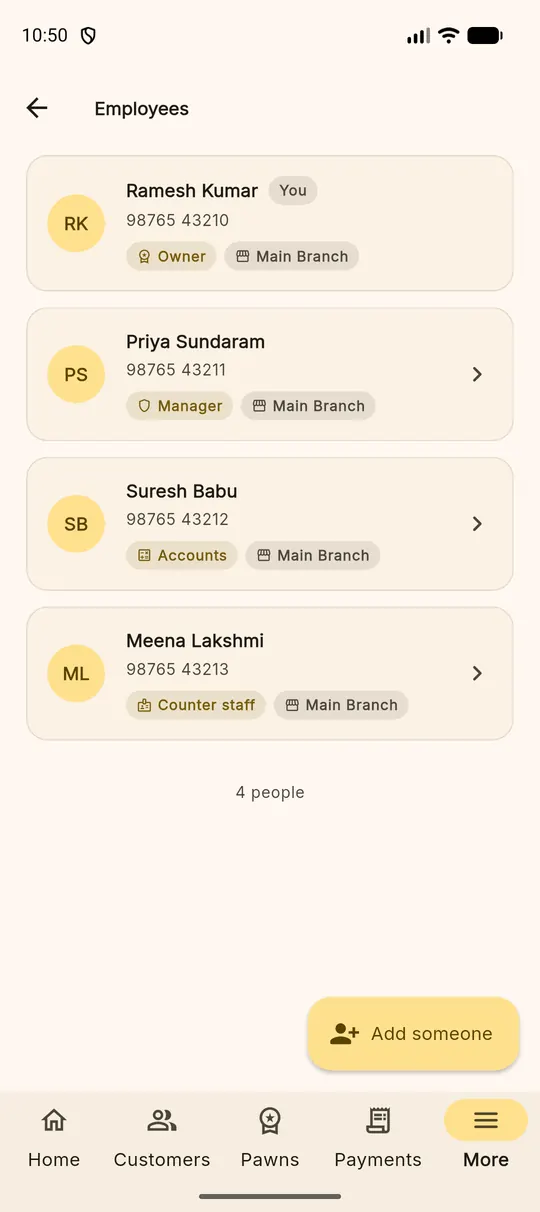
Once more than one person works the counter, "who wrote this pledge?" becomes a daily question. Roles answer the version of it that matters most — a clerk should not be changing the rate board or the interest schemes — and attribution answers the rest: every pledge, payment, reversal and custody move carries a name.
This is the part that makes an end-of-day discrepancy a five-second question instead of an evening.
One branch or six
Multi-branch features are usually where pricing jumps, which is backwards: the obligations above apply to a single counter exactly as they do to a chain. A one-shop broker should get the KYC handling, the custody trail and the attribution without buying an enterprise tier, and should be able to add a second branch later without migrating anything.
The practical test is whether staff are scoped sensibly. A member of staff wants a home branch — the one their work defaults to — rather than a wall; an owner walking between two shops should not be locked out of either.
What to ask
- Can anyone in your company read a customer's full Aadhaar number? (The right answer is no, including you.)
- Can a custody entry be edited or deleted? By whom?
- Does adding a second branch cost more, and does it require a migration?
- Is a reversed payment still visible in the day book?
Our answers are on the pawn broker software page, with the detail of the encryption on data security. The custody rules specifically, and what the Tamil Nadu Pawn Brokers Act expects for unredeemed articles, are covered in custody, auctions and branches.