 PawnEasy Pro
The short version
- Custody deserves the same rigour as the ledger: a place for every article and a record of every move.
- Storage types differ by who has to be asked to open them — your locker, a bank, or a custodian.
- Unredeemed articles follow a legally prescribed procedure; software should support that process, never pre-empt it.
- A second shop means a second pawnbroker licence in Tamil Nadu, and a head office that needs one view of both books.
Custody is half the business
Every article that comes over the counter has to be findable, identifiable and returnable — possibly a year later, possibly to somebody other than the borrower, and possibly under question from an auditor. That is a different discipline from lending, and it fails in different ways: not a wrong number, but a missing packet.
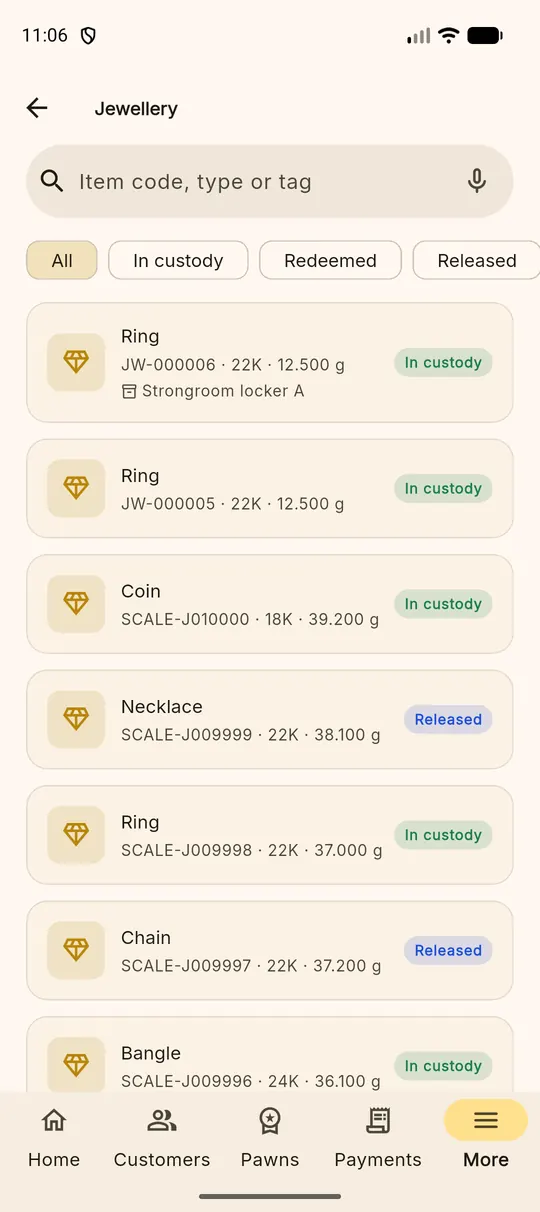
The discipline that makes it work is simple to state. Nothing moves without a record. In PawnEasy Pro that is an append-only custody trail on each article: taken in at intake, placed in a location, moved if it moves, released at redemption. Entries are never edited or deleted — a mistake is corrected by another movement, and both stay visible. That is what lets you answer "where has this chain been?" instead of "where is it now, probably?"
Three kinds of storage, because three kinds of key
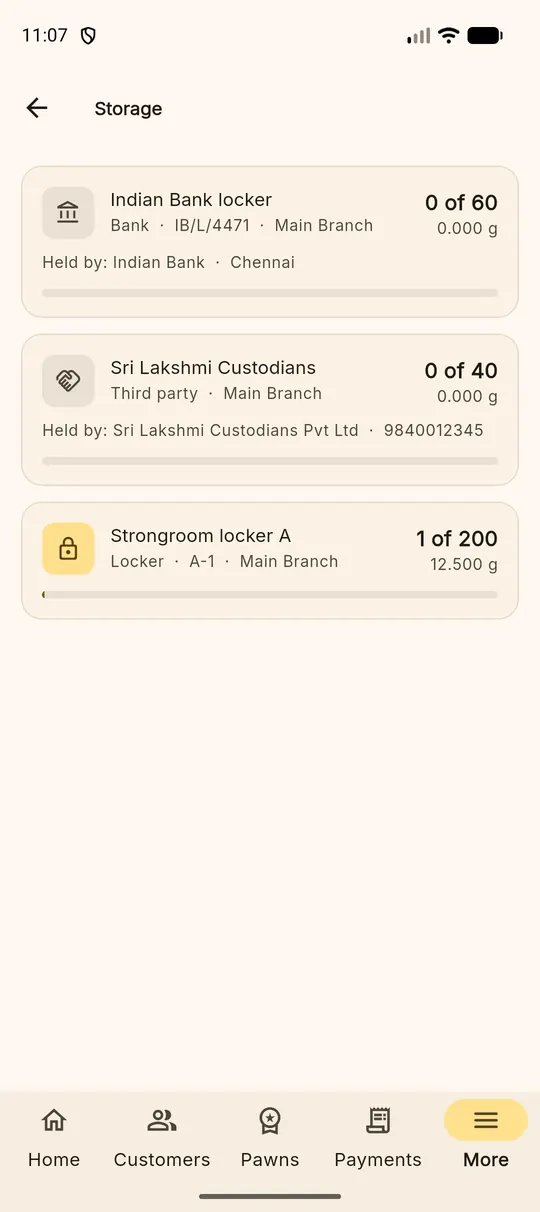
Shops describe their storage in a dozen words — safe, vault, locker, bank, godown — but operationally there are only three cases, distinguished by who has to be asked before the gold can be reached:
| Type | Who opens it | What else to record |
|---|---|---|
| Locker | You — it is on your premises | Branch, capacity |
| Bank | The bank, in banking hours | Which bank and branch, a contact |
| Third party | A custodian, by telephone | Who holds it, and their number |
The practical consequence of that distinction is retrieval time. A customer who wants their chain this afternoon can have it if it is in your locker, and cannot if it is at a bank that closed at four. Knowing which — before the customer is told — is the difference between a service and an apology.
Three things are refused on purpose when placing an article: a retired location, a location standing in another branch, and a locker with no room left. The capacity check counts the whole packet, so three bangles into two free slots is refused at the counter rather than after two are already in. Details are in the strongroom guide.
Unredeemed articles: procedure, not automation
Sooner or later a pledge is not redeemed. In Tamil Nadu the treatment of unredeemed articles is governed by the Pawn Brokers Act and its Rules — notice requirements, the prescribed sale process, and the accounting for surplus or shortfall against the amount owed.
Software has an obvious role here and an obvious limit. The useful role is identification and evidence: which loans are past maturity, by how long, what is owed, which articles are attached, and a complete history of what the customer was told and when. The loan book report and the reminder log between them produce most of that.
What software should not do Automatically mark an article for sale. Auction is a legal process with notice periods and consequences for getting it wrong; a system that flips a status on a timer creates exposure rather than removing it. PawnEasy Pro surfaces overdue and matured loans and keeps the record; the decision, the notices and the sale remain the broker's, under the applicable rules.
What changes when the second shop opens
Two things change immediately, one legal and one operational.
Legal: under the Tamil Nadu Pawn Brokers Act, a broker operating more than one shop or place of business needs a separate licence for each. The second branch is not an extension of the first in the eyes of the Act.
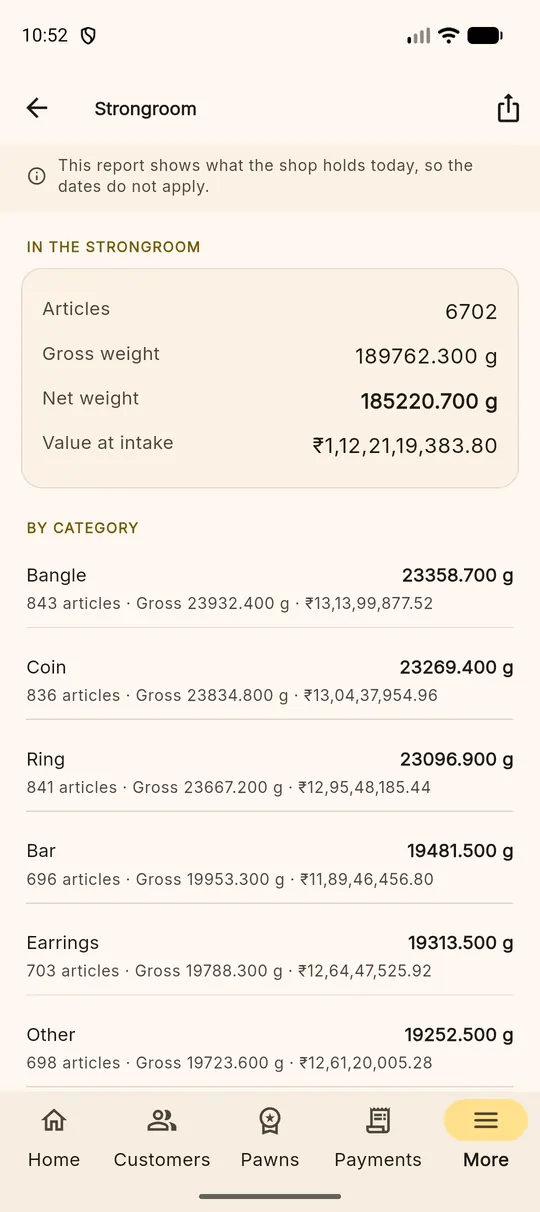
Operational: the owner stops being able to see the business by standing in it. Head office now needs one screen that answers: how many pledges are live across both shops, how much is outstanding, what came in today, what is overdue, what is in each strongroom.
In PawnEasy Pro, staff have a home branch so their day starts in the right place, and storage locations belong to a branch so gold cannot be recorded in Erode and fetched in Karur. A branch is a home, though, not a wall: the company's book stays visible to the people who should see it. See Staff and settings for how the four roles divide the work — owner, manager, accounts, counter.
Why this argues for a cloud system rather than a PC in each shop
A server in every branch means a database in every branch, and therefore a reconciliation problem, a backup problem and a "which machine has the real figure?" problem. One central database with role-based access removes all three: branches write to the same book, head office reads it live, backups happen once, and updates arrive everywhere at the same time.
It also removes the failure mode that ends businesses — the counter PC whose hard disk dies with the only copy of the pledge register on it.
Practically, that means the counter clerk uses the Android app on a handset and the owner or accountant uses the web portal in a browser, on the same records, from wherever they are.