 PawnEasy Pro
The short version
- A pledge converts an owned asset into short-term liquidity, with the asset recoverable on repayment.
- Customers come for emergencies, working capital, sowing season, school fees and ordinary household gaps — rarely for luxuries.
- Behind one simple transaction sit fifteen distinct things a broker must track, and they all grow with volume.
The transaction, in one line
A customer pledges a valuable item; the broker lends against it; the customer repays with interest; the item comes back.
That is the whole shape of it, and its simplicity is why the business has outlived every wave of financial modernisation. If the pledge is not redeemed according to the agreed terms and the applicable law, the article may eventually be dealt with through the prescribed process — including sale or auction where that applies — but that is the exception, not the design.
What makes it different from retail is that the shop is holding something that belongs to somebody else, has sentimental as well as monetary value, and must be returned in the condition it arrived in, possibly a year later. A shop is therefore running two businesses at once: a lending book and a custody operation.
Why customers come
The fundamental need is short-term liquidity. A family may own ₹3 lakh of gold and still not have ₹80,000 available this week. Selling the jewellery disposes of the asset permanently. An unsecured loan means documentation, assessment and time the customer does not have.
1. Emergencies
Medical expenses, family emergencies, an urgent household bill. The customer is not shopping for a rate; they need money before the end of the day.
2. Working capital
A shopkeeper needs stock today and expects payment in three weeks. Gold bridges the gap cheaply and without a credit file.
3. Agriculture
Farm income is seasonal; expenses are not. Seeds, fertiliser, labour, irrigation, equipment and harvest costs all land before the crop does. Pledge volumes in agricultural belts follow the sowing calendar closely enough that a good broker can predict the week.
4. Education
College fees, school expenses, hostel and examination fees — usually at fixed points in the year, often against a repayment plan the family already has in mind.
5. Ordinary household requirements
Weddings, repairs, a festival, a debt falling due. Small secured borrowing is a normal part of household finance, not a sign of distress.
Why this matters operationally A customer borrowing for the sowing season expects to redeem after the harvest. One borrowing for a medical emergency may pay interest monthly for a year. Both are good customers, and they need different reminder timing. That is why a reminder schedule should be yours to set rather than the software's to decide.
Fifteen things a broker tracks
The transaction is simple. Running a hundred of them a week is not. A pawn business has to manage, simultaneously:
| People and money | Goods and paperwork |
|---|---|
| Customers · Loan amounts · Interest · Due dates · Renewals · Part payments · Redemptions · Cash | Pledged articles · Inventory and custody · Receipts and pawn tickets · Auction procedure · Customer communication · Accounting · Compliance records |
Each of those is manageable on paper at low volume. Every one of them becomes a source of error as volume grows — and they compound, because a wrong weight becomes a wrong valuation becomes a wrong loan becomes a wrong interest figure becomes an argument at the counter.
The thing customers are actually buying
Ask a customer why they use one shop over another and the answer is rarely the interest rate. It is some version of: they know me, and they know where my chain is.
Trust in this trade is made of small operational competences. The broker who can state the exact balance without a five-minute search. The one whose receipt shows how a payment was split between interest and principal. The one who produces the right packet from the right locker the first time. None of that is romance about the old ways — it is record keeping, and record keeping is precisely what software is for.
And it is a regulated trade
In Tamil Nadu, the Pawn Brokers Act, 1943 requires a licence, prescribes what a pawn ticket must carry, and lays down the procedure for records, redemption and the sale of unredeemed articles. A broker with more than one shop needs a separate licence for each place of business.
None of that is difficult to comply with. It is difficult to evidence from a notebook a year after the fact — which is the real argument for a digital pledge record with an audit trail that cannot be quietly edited.
Where this goes
A shop that understands why customers come can serve them faster than a shop that does not. A shop that also has its book, its strongroom and its due dates on one screen — on a phone at the counter and in a browser at the desk — can serve them faster still.
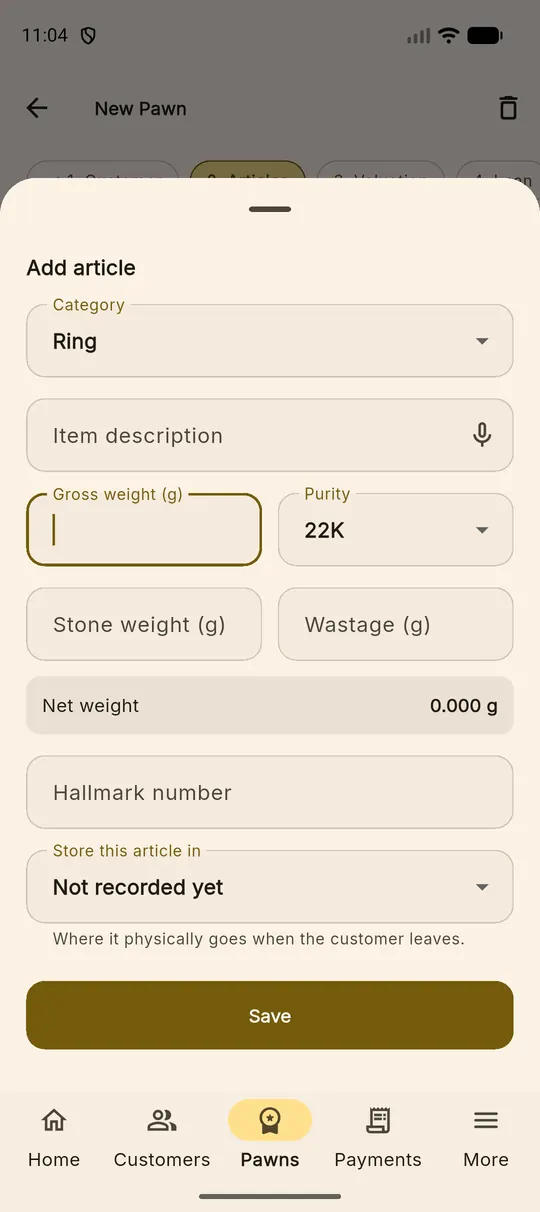
PawnEasy Pro is built around exactly the flow described above: the customer, the articles, the valuation against today's rate, the loan, and the receipt. If you want to see it step by step, the pledge walk-through shows every screen.