 PawnEasy Pro
1. A pledge is a loan against articles
When a customer brings gold, you create a pledge — the app calls it a
pawn, and gives it a number like PT-2026-000005. A pledge holds three
things together: the customer who borrowed, the articles
that came in, and the money that went out with the terms it runs on.
Everything else in the app hangs off that: payments belong to a pledge, articles in the strongroom belong to a pledge, reminders are about a pledge, and every report counts pledges one way or another.
2. Articles are weighed, not guessed
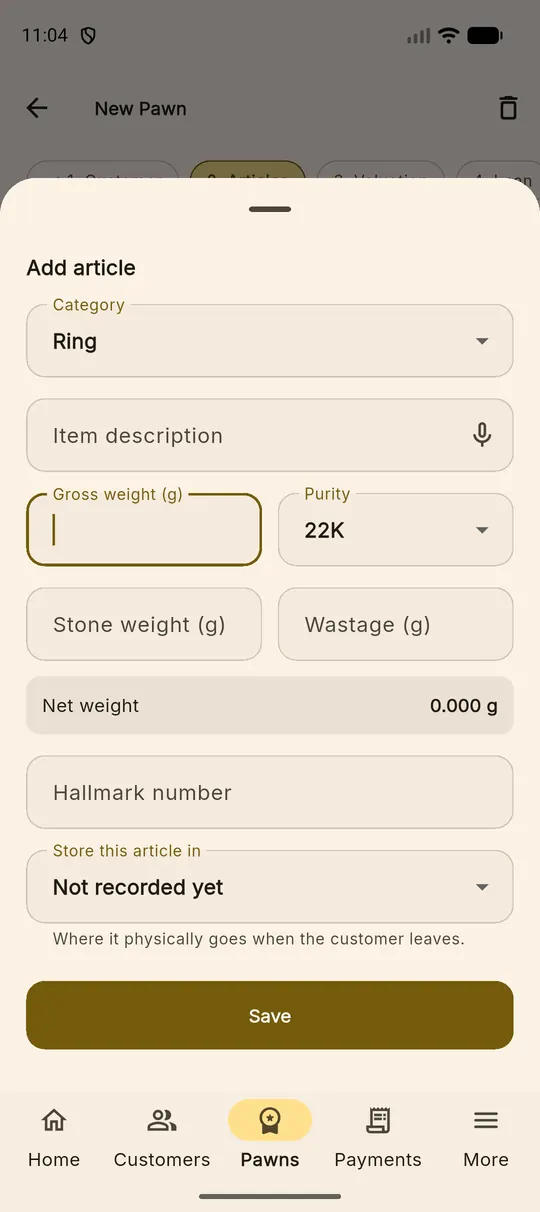
Each article is recorded on its own — a ring, a chain, a pair of earrings — with a category, a purity in karats, and three weights:
| Weight | What it is |
|---|---|
| Gross | What the scale says with everything on it |
| Stone | Stones, beads and thread that are not gold |
| Wastage | What you deduct by trade custom for solder and loss |
Net weight is what is left, and it is the only weight that is lent against. The app works it out as you type, so the customer can see the arithmetic rather than being told a number.
3. The rate board decides the value
Each morning you publish the day's rate per karat. A 22K rate prices 22K gold — it is the rate you would actually pay for that metal, not a fine-gold rate to be adjusted afterwards. Every pledge written that day is valued against the board, and the maximum loan is a percentage of that value.
Correcting the rate never rewrites a loan A pledge keeps the rate it was valued at. If you fix a typo in this morning's board at noon, this afternoon's pledges use the new number and this morning's stay exactly as they were written. That is what makes the book trustworthy.
4. The scheme is frozen onto the loan
An interest scheme is your lending policy: the rate per month, how it is worked out, the tenure, any grace period, the penalty after maturity and how amounts are rounded. You set your schemes up once, in the web portal.
When a pledge is created it takes its own copy of those terms. From that moment the loan is governed by the copy, not by the scheme. You can raise your rate next week, retire a scheme, or rewrite it entirely, and not one loan already on the books moves by a rupee. Ask any shop that has changed rates mid-year why this matters.
5. Gold moves only on the record
Every article carries an append-only custody trail. Taking a pledge puts the articles into custody. Putting them in a locker records where. Moving them to the bank records the move. Redeeming releases them. Nothing is ever quietly edited — a mistake is corrected by another movement, and both stay visible.
This is why the app asks "where does this go?" at intake rather than later. A storage location is one of three things:
| Type | Who has to be asked to open it |
|---|---|
| Locker | Nobody — it is on your premises |
| Bank | The bank, in banking hours |
| Third party | A custodian you have to telephone |
If you have not set your lockers up yet, you can still lend: those articles show as unplaced on the storage page until you put them away properly.
6. Money is allocated, never overwritten
A payment against a loan is split in a fixed order — penalty first, then interest, then principal — and the split is shown before you accept the cash and printed on the receipt. A payment is never edited afterwards: if it was wrong, it is reversed with a reason, and both entries remain in the daybook.
Two other things are recorded honestly rather than conveniently:
- A discount is interest forgiven, not cash you pretend arrived. Your collection figures stay true.
- A handover at redemption records who actually collected the gold, which is often a son, a neighbour or a driver rather than the borrower.
Putting it together
A pledge is created against a rate and a scheme, its articles go into custody, interest accrues by the frozen terms, payments are allocated against it, and one day it is redeemed: the money closes and the articles are released to a named person. Every report in the app is a different way of counting those same events.